Chinese Whispers

There is a kind of contemporary gossip that does not spread because it is true, but becomes true because it spreads. The more it is repeated, the more it acquires the comforting shape of common sense, as it does not need evidence, and it rarely tolerates context. In the last couple of years, one phrase has become almost compulsory in any conversation about innovation, technology, industrial strategy, education reform, artificial intelligence, productivity, or the future of work: “look at what China is doing“. It is usually delivered as a mic drop, not as an invitation to think. But what is striking is how rarely it is used to understand China, while more often, it is used to validate a Western argument that has very little to do with China at all.

The move is familiar. Someone selects a handful of decontextualised facts about Chinese growth, Chinese industrial capacity, Chinese scale, Chinese speed, and then uses them as proof that Western countries should get out of the way, deregulate, stop overthinking, weaken standards, and let private actors move fast. China is not really being analysed, but it is being used as a prop. The phrase functions as a shortcut to avoid the harder conversation, which is that China’s current state of development is the product of decades of consistency, long term planning, heavy public investment, and a state that is present at every level of the economic and technological system.

Because China did not get here by accident, nor by the invisible hand finally being allowed to do its work. China’s achievements are the fruit of a formula, and it is a formula that many of those invoking the phrase explicitly reject. It includes strong regulatory frameworks and enforcement capacity, industrial policies that picked winners and losers rather than pretending the market would do it neutrally, strategic coordination between state, finance, universities, and industry, and a political system capable of sustaining priorities over time rather than rewriting the national agenda every few years. One can criticise this model, but one cannot pretend it is laissez faire.

Research and development is a good place to start. China’s R&D spending is now among the highest in the world, measured in the hundreds of billions of dollars annually, and it continues to grow. In some global estimates, China accounts for roughly a quarter of total world R&D spending, and this is not a story of venture capital alone. It is a story of coordinated national capacity building where the country has treated innovation not as a romantic accident, but as an infrastructure, something that must be funded, organised, and defended.

Education tells the same story. China has invested heavily in STEM, and it shows in the scale of its technical workforce, although the more interesting point is what this investment is paired with. China has not treated social sciences, humanities, business, and legal studies as dispensable luxuries, understanding that these disciplines are needed to manage complex economies, to govern institutions, to design policy, and to assess the social and human impact of development. In other words, China’s approach has been far closer to a holistic state capacity model than to the Western fantasy of a nation of coders and entrepreneurs improvising their way to global leadership.

Clean technology and net zero make the contradiction even sharper. China has become a dominant global force in solar manufacturing, batteries, electric vehicles, and clean energy supply chains, all which did not happen because China embraced deregulation and then stepped aside. It happened because China combined industrial policy, strategic subsidies, infrastructure investment, and coordination at scale. It treated clean technology as an economic strategy and a geopolitical opportunity. It also treated it as a matter of national resilience.

And here the Western use of the phrase becomes almost surreal, because some of the loudest voices saying look at China are the same voices opposing net zero policies at home. They will point to Chinese industrial strength in one sentence, and then attack climate policy in the next, often through a bizarre cultural shortcut that frames decarbonisation as woke, as if atmospheric physics were a political ideology. None of this is supported by serious evidence, being a performance, designed to collapse a complex policy conversation into a culture war gesture. It is also, frankly, incoherent, because China’s development strategy has taken clean technology seriously precisely as a route to industrial leadership.

This is why the look at China refrain so often misleads. It is not simply that it simplifies China, btu that it reverses China. It treats China’s results as if they were proof of a free market logic, when they are in fact the outcome of long term state direction. It treats speed as if it came from deregulation, when it often comes from planning, coordination, and the ability to mobilise resources. It treats scale as if it were a natural feature of markets, when it is frequently the product of deliberate industrial strategy.

Underneath all of this lies a deeper difference, not just in tools but in philosophy, one in which China’s model, whatever its flaws, is organised around development framed as collective. It is not primarily about granting private actors maximal freedom to extract value, but about achieving national objectives, including industrial upgrading, technological self reliance, infrastructure expansion, and increasingly, strategic dominance in green industries. The Western discourse that often accompanies the look at China phrase tends to be the opposite, not being really about development or even economic growth. It is about deregulation as ideology. It is about expanding the space for profit, weakening the space for public interest, and presenting any constraint, whether environmental, labour, consumer, or human rights based, as a barrier to innovation.

And this is where the conversation about profit becomes revealing. Profit is not forbidden in China, and becoming rich is neither rare nor illegal. There are billionaires, large private firms, and highly competitive markets in many sectors, but what is far less tolerated, at least in principle and often in practice, is the idea that private profit should be pursued without boundaries, even when it harms society, undermines strategic goals, destabilises institutions, or creates risks that the public will later be forced to absorb. In other words, China has allowed wealth, but it has not endorsed the licence to profiteer. Yet it is precisely that licence, the freedom to extract value at the expense of social cohesion, long term resilience, or national capability, that some Western advocates of the “look at China” slogan seem to want. They praise China while asking for something that China itself would not permit.

In practice, this becomes less a model of innovation than a model of licence to profiteer, where the public pays for the disruptions while a narrow segment captures the gains. China’s model may be many things, but it is not that, being far more disciplined, far more coordinated, and far more explicit about the idea that the state exists to shape outcomes.

None of this means Western countries should copy China, which would be unrealistic, and in many respects undesirable. But it does mean that Western debates should stop using China as a rhetorical shortcut. If China is to be invoked, it should be invoked honestly. China’s achievements did not emerge from deregulation. They emerged from state capacity, long term investment, enforcement, industrial policy, and an explicit commitment to development as a national project.

Chinese whispers are dangerous not because China is inherently dangerous, but because whispers replace analysis, allowing slogans to substitute for strategy. They also allow people to borrow authority from a country they are not actually describing, and they allow the public to be told that the answer is obvious, when in fact the answer is hard, demanding choices.

If we are serious about innovation, industrial renewal, and net zero, we need less gossip and more governance. Less slogan and more system. And we need to stop pretending that we can get China’s outcomes while rejecting the very formula that made those outcomes possible.

European tech sovereignty or the problems when public goods run on private code

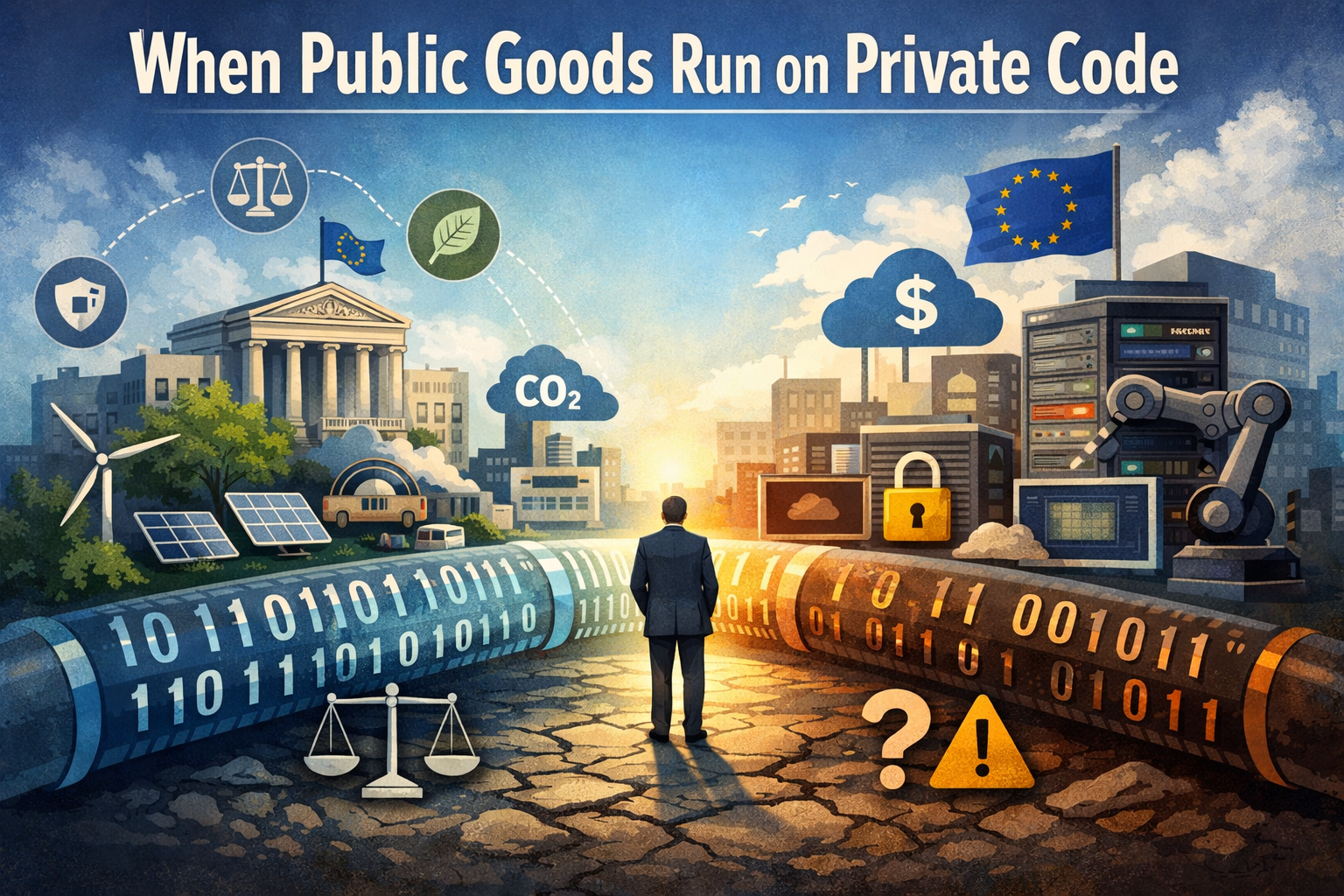
I recently submitted a paper on artificial intelligence, carbon markets and sustainability governance in the European Union, where I repeatedly return to a structural problem that goes far beyond climate policy and moves to the heart of the current debates about European teach sovereignty. Public goods are increasingly governed through private digital infrastructures. This is not a marginal technical issue. It is a constitutional one.

Debates on digital sovereignty often focus on platforms, clouds or communications tools. The deeper issue sits one layer below, in the infrastructures of verification, trust and coordination that now underpin core public functions, from justice and public administration to climate governance and sustainability reporting. When these infrastructures are privately designed, operated and controlled, the state does not merely outsource services, but it delegates power.

This is particularly visible in carbon markets and sustainability reporting, where systems of measurement, reporting and verification have become the backbone of regulatory effectiveness. Emissions are no longer governed primarily through inspections or permits, but through data pipelines. Sensors, platforms, algorithms, standards and registries translate physical reality into data, data into compliance and compliance into legal and economic consequences. Whoever controls that translation layer exercises a form of functional sovereignty.

Private digital infrastructures are often presented as neutral, efficient and scalable. In practice, they embed choices about methodologies, thresholds, defaults and visibility. In carbon markets, this means deciding what counts as a real reduction, how uncertainty is treated, how anomalies are detected and which data are considered authoritative. These are not technical details. They are normative decisions with distributive effects.

The problem is not the involvement of private actors. European regulation has long relied on hybrid governance. The problem is that the architecture itself is frequently opaque, fragmented and weakly accountable. In sustainability governance, this has translated into inconsistent MRV standards, low quality carbon credits, greenwashing risks and a widening gap between regulatory ambition and implementation capacity. Similar patterns appear whenever public objectives depend on proprietary systems governed by foreign legal orders or commercial incentives.

Recent European moves away from non European digital services in the public sector are often framed as geopolitical reactions, but they are also responses to a rule of law risk. When public institutions rely on infrastructures they do not control, continuity of service, data integrity and institutional autonomy become contingent.

This risk is particularly acute in sustainability governance. Climate policy is cumulative and long term. It depends on historical data, methodological consistency and institutional memory. Vendor lock in, opaque algorithms or sudden changes in service conditions can undermine not only efficiency but also legal certainty and democratic legitimacy. A carbon market that cannot credibly verify emissions is not merely inefficient. It is normatively hollow.

What follows from this is not technological isolationism. The European response, increasingly visible in policy, is more structural. Certain digital systems must be treated as regulatory public goods. This includes MRV infrastructures, digital identity, trust services, registries and core data spaces. The objective is not that the state builds everything itself, but that the rules of the system, its interoperability, auditability and ultimate control remain public., and for that there should be certainty that they are subject to European law.

This is where the European digital rulebook matters. Instruments such as data protection law, the artificial intelligence framework, digital identity rules and cybersecurity obligations are often criticised as burdens, although their deeper function is infrastructural. They aim to ensure that innovation occurs within an environment where public values such as rights, accountability and proportionality are not external constraints but design parameters.

In the sustainability domain, this logic is already visible in the gradual move away from purely private carbon standards toward European level certification, registries and verification rules, and the lesson generalises for other tech domains. If the objective is public, the infrastructure cannot be entirely private.

The real risk for Europe is not that it regulates too much, but that it confuses speed with progress. Innovation built on fragile and unaccountable infrastructures ultimately erodes trust, and trust is itself an economic and political asset. By insisting that core digital infrastructures serving public purposes remain governed as such, Europe is not rejecting innovation. It is redefining its conditions, and contradictorily making it more pro innovation by giving legal certainty, which the ill conceived onmibus package is eroding.

Digital sovereignty, understood this way, is not about borders in cyberspace. It is about ensuring that when public goods run on code, that code is embedded in a legal and institutional architecture compatible with European constitutional principles. This approach is slower and more demanding, but it is substantially more resilient, and in a world where governance increasingly happens through systems rather than statutes, resilience may be Europe’s most underestimated innovation strategy.

Resilience, AI, and the sustainability rift revealed at Davos

When the World Economic Forum convenes each year in the Swiss Alps, it performs the paradox of a gathering of global elites claiming to represent the world even as they expose its fractures. In 2026, that paradox was laid bare by a tale of two speeches, one by Canadian Prime Minister Mark Carney that mourned the decline of a rules based global order and called for a cooperative response, and another by a U.S. president whose rhetoric reflected a very different, often unilateral, logic of power. The contrast between these visions mirrors the tensions now surfacing across the technological and environmental frontiers where AI and sustainability intersect.

Carney’s address was striking not simply for its sharp geopolitical diagnosis, that the orders of the past are fracturing under the strain of great power rivalry, but because it explicitly linked this rupture to the need for collective responses grounded in values, sovereignty, and sustainable development rather than coercion. He challenged the Davos audience to stop invoking an illusion of rules based stability and instead build alliances that reflect the realities of geopolitical competition and ecological crisis.

In contrast, and much commented upon in the global press, other speeches and reactions at Davos captured a very different mood, represented by competition over strategic assets like Greenland, tariff threats, and rhetorical appeals to national ascendancy rather than shared stewardship. This tension, between cooperation and competitive assertion, has direct implications for how humanity manages two of the defining challenges of our era: the governance of AI and the sustainability of our planetary systems.

AI, sustainability, and the fragility of resilience

In their idealised forms, AI and efforts to decarbonize our economies might seem complementary, where intelligent systems optimise energy use, accelerating climate modeling, and enhancing adaptive capacity across sectors. Yet at Davos, the debate revealed that the very governance structures which will shape AI deployment and climate action are also splitting along familiar economic and geopolitical lines.

On the AI front, discussions underscored a stark asymmetry: while leaders in the Global North emphasise competitiveness, AI sovereignty, and market advantage, much of the Global South worries about infrastructural dependency, digital extraction, and corporate control. From the vantage of emerging and middle powers, AI is less a tool of empowerment than a conduit through which external norms and economic leverage are exercised. This divergence mirrors long standing concerns that sustainability commitments are too often decoupled from the very power asymmetries that produce environmental harm in the first place.

The sustainability dimension was itself present in panels emphasising the environmental costs of AI, from energy intensive data centers to the material extraction required for high performance computing hardware. Leaders at Davos spoke of human centered AI and structural responses like AI taxation and safety nets for displaced labour, yet such frameworks remain aspirational and unevenly backed by policy. Where AI is subsidised without ecological accounting, efficiency gains risk becoming externalising mechanisms, one of improvements on paper that shift costs onto communities, ecosystems, and future generations.

A fractured global response to shared risk

The rift revealed in Davos reflects deeper structural tensions, in technological competition versus collective stewardship, national sovereignty versus transnational governance, and short term advantage versus long term ecological and economic viability. Carney’s call for middle powers to act together is, at its heart, a plea for a world that sees cooperation not as a luxury but as a survival strategy.

This is precisely where resilience must be rethought. Resilience cannot be merely adaptive; it must be transformative. It must take into account the uneven capacities of countries and communities to shape the trajectory of both AI and sustainability transitions. A Global South community that cannot contest algorithmic systems or influence data governance will find itself bearing not just technological dependencies but also environmental burdens and economic marginalization.

Carney’s framing, that the old order is gone and a new one must be built consciously, cooperatively, and sustainably, resonates with broader debates about the limits of adaptation. Resilience without justice is hollow, as adaptation that ignores structural inequities will reproduce vulnerability rather than dissipate it.

Toward a new architecture of governance

A truly sustainable and resilient future demands coherence between AI governance, climate policy, and global economic structures, and Europe has shown how can be done. This requires at least four shifts:

  • Distributed Agency: AI systems must be designed and governed as public infrastructures, not proprietary black boxes controlled by a handful of hyperscale firms and powerful states. This is essential for equitable resilience.
  • Ecological Accountability: AI’s environmental footprint, from hardware lifecycles to energy demand, must be integrated into governance frameworks, not treated as an afterthought in efficiency narratives.
  • Transnational Cooperation: The fractures evident at Davos remind us that unilateral power politics undermine collective action. Shared risks, climate tipping points, AI displacement, digital exclusion, cannot be managed by any one state acting alone.
  • Capacity Building in the Global South: Resilience will be meaningful only if countries with fewer resources can shape rules rather than have them imposed, whether in trade, technology, or climate finance.

Governance as the central frontier

The Davos narratives of 2026, from geopolitical tensions over Greenland to calls for new alliances, highlight the fundamental truth that we are living through a structural rupture, not a smooth transition. The futures of AI governance and sustainability are not separate questions; they are interlocked because both challenge the assumptions of unilateral power, short term gain, and technocratic neutrality.

To cultivate resilience in this era is not to adapt quietly to what is coming, but to forge systems of governance that reflect human values, ecological limits, and shared vulnerability. As global discussions fragment along lines of power and interest, the risks of fragmentation grow. But so does the possibility that communities, cities, nations, and coalitions, especially those historically marginalised, will insist on governance that is inclusive, sustainable, and just.

Our resilience, and that of the planet, depends on nothing less.

What Europe’s Policy Reversals Mean for Sustainability, Business and AI

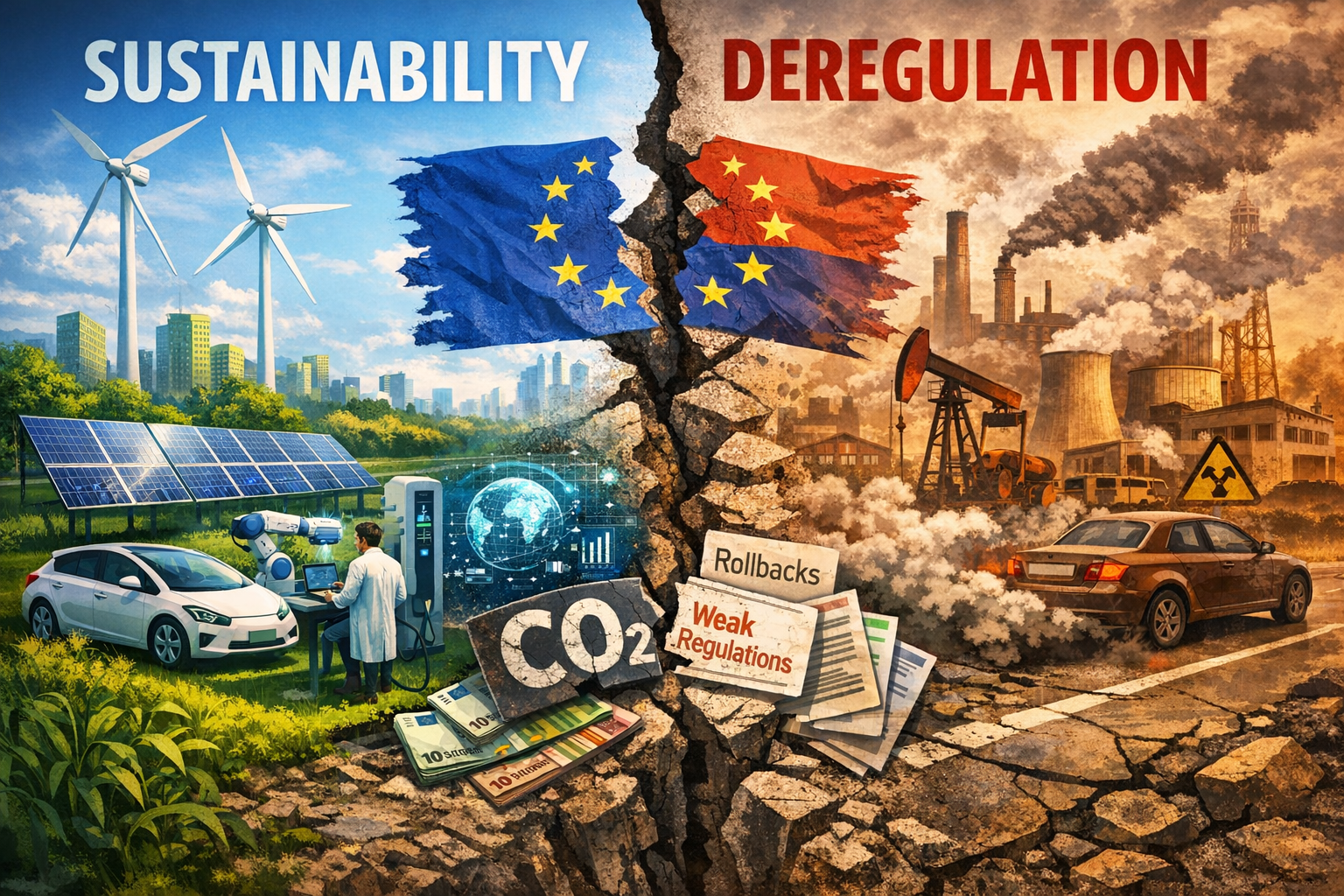
As Europe begins 2026, the continent finds itself at a crossroads in the governance of sustainability, technology and industry. Policymakers across the European Union and the United Kingdom are increasingly embracing deregulatory reforms, promoted as necessary to enhance competitiveness, stimulate investment and ease administrative burdens on business. Yet these reforms, when examined together, reveal a structural shift away from the sustainability frameworks that have shaped corporate accountability, environmental protection and long term innovation strategies over the past decade. This shift is more than a matter of regulatory calibration, reflecting a political economy in which deregulation is treated as an end rather than a means.
Recent policy changes, from the weakening of the EU’s sustainability reporting regime and shifts in nuclear regulation, to the potential rollback of the 2035 internal combustion engine ban and pressure to relax AI governance frameworks, suggest a broader reorientation. The cumulative effect is to elevate short term economic calculations over long term resilience and systemic stewardship.

1. The Retreat from Sustainability Reporting

Just last week, the European Council and the European Parliament agreed to significantly simplify the Corporate Sustainability Reporting Directive (CSRD) and the Corporate Sustainability Due Diligence Directive (CSDDD). Under the revised framework, only companies with over 1,000 employees and €450m in annual turnover remain in scope for mandatory sustainability reporting, while due diligence obligations now apply only to firms with more than 5,000 employees and €1.5bn in turnover. Moreover, mandatory climate transition plans and certain reporting requirements were eliminated, and a large proportion of smaller businesses were exempted from the rules entirely. This retreat removes approximately 90 % of companies from CSRD’s scope and 70 % from CSDDD’s remit, dramatically shrinking the regulatory perimeter of corporate accountability.

What was initially designed to standardise environmental, social and governance (ESG) disclosures now risks becoming an optional add-on. The scaling back of reporting thresholds reduces transparency and weakens the incentives for firms to integrate sustainability into core business strategies. Rather than equipping investors and stakeholders with reliable data on climate risk, supply chain impacts and human rights performance, the revised regime favours voluntary approaches, an outcome that benefits larger firms with entrenched reporting capacities but leaves rising enterprises and mid sized suppliers in a regulatory limbo.

2. Deregulation in High-Risk Sectors

The United Kingdom’s efforts to streamline nuclear regulation similarly illustrate the risks of deregulation in domains where environmental and safety stakes are high. Recent proposals to simplify planning, environmental and safety oversight for nuclear projects have drawn criticism for sidelining ecological expertise and reducing the scope of environmental assessments. While proponents argue that regulatory fragmentation has contributed to high costs and delays, critics warn that diminishing safety and environmental safeguards could erode public trust and undermine long term energy sustainability.

Similar tensions are visible across energy policy more broadly. Though the EU has prioritised energy grid upgrades and infrastructure resilience in recent years, the broader deregulatory frame risks reducing environmental assessment to procedural formality rather than substantive governance, especially when energy transitions intersect with local ecological concerns.

3. The Combustion Engine Backtrack

Shortly before Christmas 2025, yesterday to be precise, the European Commission announced a major shift in its automotive climate policy, proposing the easing of the 2035 ban on new internal combustion engine (ICE) vehicles, following intense pressure from Germany, Italy and major automakers. Under the original rule, all new cars and light vans sold in the EU from 2035 were to emit zero tailpipe CO₂. The revised plan now targets a 90 % reduction in CO₂ emissions from 2021 levels by 2035, instead of a full zero emission mandate, and allows continued sales of plug-in hybrids and vehicles powered by synthetic fuels or non-food biofuels.

The retreat from a hard combustion engine ban comes amid headwinds for the European auto industry, slower than expected electric vehicle (EV) adoption, intense competition from Chinese EV manufacturers, and rising costs for infrastructure and battery supply. Automakers have lobbied vigorously for flexibility, arguing that plug-in hybrids, biofuels and alternative compliance schemes are necessary to preserve jobs and industrial capacity.

Environmental advocates and many EV-focused companies, including Volvo, have criticised the shift as a setback for Europe’s climate leadership, a potential drag on investment in electrification, and as a move to hide the sector’s inefficiencies and poor business choices. Critics argue that diluting the target undermines regulatory predictability and could leave Europe lagging in the rapidly growing global EV market, especially as China accelerates battery vehicle deployment and U.S. policy oscillates between incentives and rollbacks.

From a sustainability perspective, this reversal illustrates how deregulatory pressures can reshape climate policy itself, not merely loosen reporting obligations or reduce paperwork, but recalibrate the very targets that define long term decarbonisation pathways.

4. AI Governance in a Deregulatory Era

Artificial intelligence poses similar governance challenges. AI technologies increasingly permeate business operations, supply chain optimisation, resource allocation and sustainability analytics. Their environmental footprint, particularly through energy intensive model training and data centre operations , is substantial, and their social impact, from labour displacement to bias amplification, is profound. Effective governance is essential to ensure that AI contributes to sustainability rather than undermines it.

Yet political pressure, particularly emanating from competitors with more permissive regulatory regimes and large corporations’ lobbying, pushed Europe toward weaker AI oversight. The result is a tension between the original EU’s risk based AI governance framework and the deregulatory narrative that frames oversight as antithetical to innovation. In practice, well designed regulation can enable innovation by providing legal certainty and aligning technological development with societal values; absence of regulation often results in fragmented standards, ethical harms and competitive disadvantage.

5. Competitive Pressures and Policy Drift

Across sectors, the deregulatory narrative shares a common rationale, and regulation is portrayed as a barrier to competitiveness; those who seek licence to profit over anything else, and to externalise their costs, have succeeded in equating regulation to sovietisation, when the truth is far from it. Whether in sustainability reporting, automotive emissions targets, nuclear licensing or AI oversight, the same fallacious claim resurfaces, regulatory simplification will catalyse growth. But this logic is flawed when it conflates short term cost reduction with strategic competitiveness. True competitiveness for businesses, particularly in the 21st century, depends on resilience, innovation rooted in environmental and social performance, and the ability to operate within predictable, transparent policy frameworks.

European firms have historically outperformed competitors in regulated spaces precisely because regulation provided structure for investment in long-term capabilities, from vaccines to aerospace and advanced manufacturing. Regulatory retreat does not inherently create advantage; it creates uncertainty.

In recent years, Europe delivered two of the COVID-19 vaccines that enabled the global economy to restart (and those invented outside the Europe also had a substantial, if not complete, state support via a pro innovation regulated environment), created the World Wide Web, and fielded aerospace technologies that continue to outperform global competitors. Airbus’ consistent lead over Boeing in deliveries, bolstered by its sustained investment in sustainable aviation and hydrogen propulsion, illustrates how regulated environments can support innovation more effectively than more permissive systems dominated by short term financial priorities that end in inefficiencies created by continuous diversion of funds and energy for damage control.

In defence technology, European capabilities such as the Meteor missile demonstrate innovation at the technological frontier, which is being adopted by other countries. In quantum communications, Europe is building coordinated sovereign capabilities, exemplified by the Eagle-1 satellite, which aims to provide secure continental networks based on quantum key distribution. These advancements are neither accidental nor the product of deregulation. They arise from structured governance, sustained investment and regulatory clarity.

Reframing Regulation as Sustainability Infrastructure

Europe’s recent policy shifts reflect more than political compromise; they signal a broader philosophical shift that elevates short term competitive narratives over the systemic goals of sustainability, transparency and innovation governance. Deregulation is not inherently harmful, but when it diminishes accountability frameworks, erodes environmental targets and reduces regulatory certainty, it undermines well-being, investor confidence and climate action.

Sustainability is not an add-on to economic policy. It is economic policy, a structural condition for resilience, competitiveness and societal stability in a world defined by the climate crisis, technological disruption and demographic change. To preserve Europe’s sustainability leadership, policymakers must recognise regulation not as a burden but as essential infrastructure, a basis on which responsible business, robust markets and trustworthy technology can thrive in the decades ahead.

Algorithmic systems and sustainability

After more than a year not even opening this almost twenty years old blog, several changes in my private and job life imply that I will return to this old pastime. I have decided to spend less time on planes and managerial roles in Higher Education, and more in research, teaching and engagement activities, meaning more time to write (with, of course, some academic and policy related travelling).

Last year we were somehow in awe for the rapid development of AI, although one could argue that what we saw was just a very fast adoption of a particular type of algorithmic systems, generative AI, while even that type of algorithmic systems have been around people’s lives for quite longer than a year and a half.

However, it is true that the irruption of generative AI and Large Language Models made algorithms a super-hot issue, so much that it seems that the whole IT law field has been swamped by AI discussions, and that there is no much else to talk about. But if the different scenarios and the obvious challenges that algorithmic systems presented to the law, seemed to quickly create a consensus (really?) in the need of regulating them, the usual tendency of lawyers, law academics, judges and policy makers to focus on what it allowed them to modify less the current legal status quo, resulted in important (fundamental) areas of law left outside of the analysis and or regulatory frenzy. One of them is the dilemmatic relationship between algorithmic systems and sustainability, which will have deep effect both in the environment and in the businesses operating in the AI field.

The argument has been that sustainability and climate change implications of AI are common to any technological and economic activity and that, at best, there should be a generic sustainability legal framework that applies to all of them, not specifically to AI. The counterarguments to that are various and can be made from different angles. From the sectorial point of view, the same could be said for the oil, the cement and the transport industries, but there is a growing body of discussions and case-law that says that their situation is not a generic one, even when generic rules are been applied to them. If we focus on the substantial issues and emissions, the old view that a different in degree big enough implies a change in class, seems to apply squarely here: something that emits substantially more than other activities and or vast amount of greenhouse gasses emissions are intrinsic to its functioning, does not share common characteristics with any technological and economic activity. Algorithmic systems are in this category, and regulating them with a focus on sustainability and climate change is essential.

In the coming days I will start to dissect the why and how that is true, coupled with the potential application of current rules, which are being used to deal with other heavy-emitter industries.