

There is a kind of contemporary gossip that does not spread because it is true, but becomes true because it spreads. The more it is repeated, the more it acquires the comforting shape of common sense, as it does not need evidence, and it rarely tolerates context. In the last couple of years, one phrase has become almost compulsory in any conversation about innovation, technology, industrial strategy, education reform, artificial intelligence, productivity, or the future of work: “look at what China is doing“. It is usually delivered as a mic drop, not as an invitation to think. But what is striking is how rarely it is used to understand China, while more often, it is used to validate a Western argument that has very little to do with China at all.
The move is familiar. Someone selects a handful of decontextualised facts about Chinese growth, Chinese industrial capacity, Chinese scale, Chinese speed, and then uses them as proof that Western countries should get out of the way, deregulate, stop overthinking, weaken standards, and let private actors move fast. China is not really being analysed, but it is being used as a prop. The phrase functions as a shortcut to avoid the harder conversation, which is that China’s current state of development is the product of decades of consistency, long term planning, heavy public investment, and a state that is present at every level of the economic and technological system.
Because China did not get here by accident, nor by the invisible hand finally being allowed to do its work. China’s achievements are the fruit of a formula, and it is a formula that many of those invoking the phrase explicitly reject. It includes strong regulatory frameworks and enforcement capacity, industrial policies that picked winners and losers rather than pretending the market would do it neutrally, strategic coordination between state, finance, universities, and industry, and a political system capable of sustaining priorities over time rather than rewriting the national agenda every few years. One can criticise this model, but one cannot pretend it is laissez faire.
Research and development is a good place to start. China’s R&D spending is now among the highest in the world, measured in the hundreds of billions of dollars annually, and it continues to grow. In some global estimates, China accounts for roughly a quarter of total world R&D spending, and this is not a story of venture capital alone. It is a story of coordinated national capacity building where the country has treated innovation not as a romantic accident, but as an infrastructure, something that must be funded, organised, and defended.
Education tells the same story. China has invested heavily in STEM, and it shows in the scale of its technical workforce, although the more interesting point is what this investment is paired with. China has not treated social sciences, humanities, business, and legal studies as dispensable luxuries, understanding that these disciplines are needed to manage complex economies, to govern institutions, to design policy, and to assess the social and human impact of development. In other words, China’s approach has been far closer to a holistic state capacity model than to the Western fantasy of a nation of coders and entrepreneurs improvising their way to global leadership.
Clean technology and net zero make the contradiction even sharper. China has become a dominant global force in solar manufacturing, batteries, electric vehicles, and clean energy supply chains, all which did not happen because China embraced deregulation and then stepped aside. It happened because China combined industrial policy, strategic subsidies, infrastructure investment, and coordination at scale. It treated clean technology as an economic strategy and a geopolitical opportunity. It also treated it as a matter of national resilience.
And here the Western use of the phrase becomes almost surreal, because some of the loudest voices saying look at China are the same voices opposing net zero policies at home. They will point to Chinese industrial strength in one sentence, and then attack climate policy in the next, often through a bizarre cultural shortcut that frames decarbonisation as woke, as if atmospheric physics were a political ideology. None of this is supported by serious evidence, being a performance, designed to collapse a complex policy conversation into a culture war gesture. It is also, frankly, incoherent, because China’s development strategy has taken clean technology seriously precisely as a route to industrial leadership.
This is why the look at China refrain so often misleads. It is not simply that it simplifies China, btu that it reverses China. It treats China’s results as if they were proof of a free market logic, when they are in fact the outcome of long term state direction. It treats speed as if it came from deregulation, when it often comes from planning, coordination, and the ability to mobilise resources. It treats scale as if it were a natural feature of markets, when it is frequently the product of deliberate industrial strategy.
Underneath all of this lies a deeper difference, not just in tools but in philosophy, one in which China’s model, whatever its flaws, is organised around development framed as collective. It is not primarily about granting private actors maximal freedom to extract value, but about achieving national objectives, including industrial upgrading, technological self reliance, infrastructure expansion, and increasingly, strategic dominance in green industries. The Western discourse that often accompanies the look at China phrase tends to be the opposite, not being really about development or even economic growth. It is about deregulation as ideology. It is about expanding the space for profit, weakening the space for public interest, and presenting any constraint, whether environmental, labour, consumer, or human rights based, as a barrier to innovation.
And this is where the conversation about profit becomes revealing. Profit is not forbidden in China, and becoming rich is neither rare nor illegal. There are billionaires, large private firms, and highly competitive markets in many sectors, but what is far less tolerated, at least in principle and often in practice, is the idea that private profit should be pursued without boundaries, even when it harms society, undermines strategic goals, destabilises institutions, or creates risks that the public will later be forced to absorb. In other words, China has allowed wealth, but it has not endorsed the licence to profiteer. Yet it is precisely that licence, the freedom to extract value at the expense of social cohesion, long term resilience, or national capability, that some Western advocates of the “look at China” slogan seem to want. They praise China while asking for something that China itself would not permit.
In practice, this becomes less a model of innovation than a model of licence to profiteer, where the public pays for the disruptions while a narrow segment captures the gains. China’s model may be many things, but it is not that, being far more disciplined, far more coordinated, and far more explicit about the idea that the state exists to shape outcomes.
None of this means Western countries should copy China, which would be unrealistic, and in many respects undesirable. But it does mean that Western debates should stop using China as a rhetorical shortcut. If China is to be invoked, it should be invoked honestly. China’s achievements did not emerge from deregulation. They emerged from state capacity, long term investment, enforcement, industrial policy, and an explicit commitment to development as a national project.
Chinese whispers are dangerous not because China is inherently dangerous, but because whispers replace analysis, allowing slogans to substitute for strategy. They also allow people to borrow authority from a country they are not actually describing, and they allow the public to be told that the answer is obvious, when in fact the answer is hard, demanding choices.
If we are serious about innovation, industrial renewal, and net zero, we need less gossip and more governance. Less slogan and more system. And we need to stop pretending that we can get China’s outcomes while rejecting the very formula that made those outcomes possible.
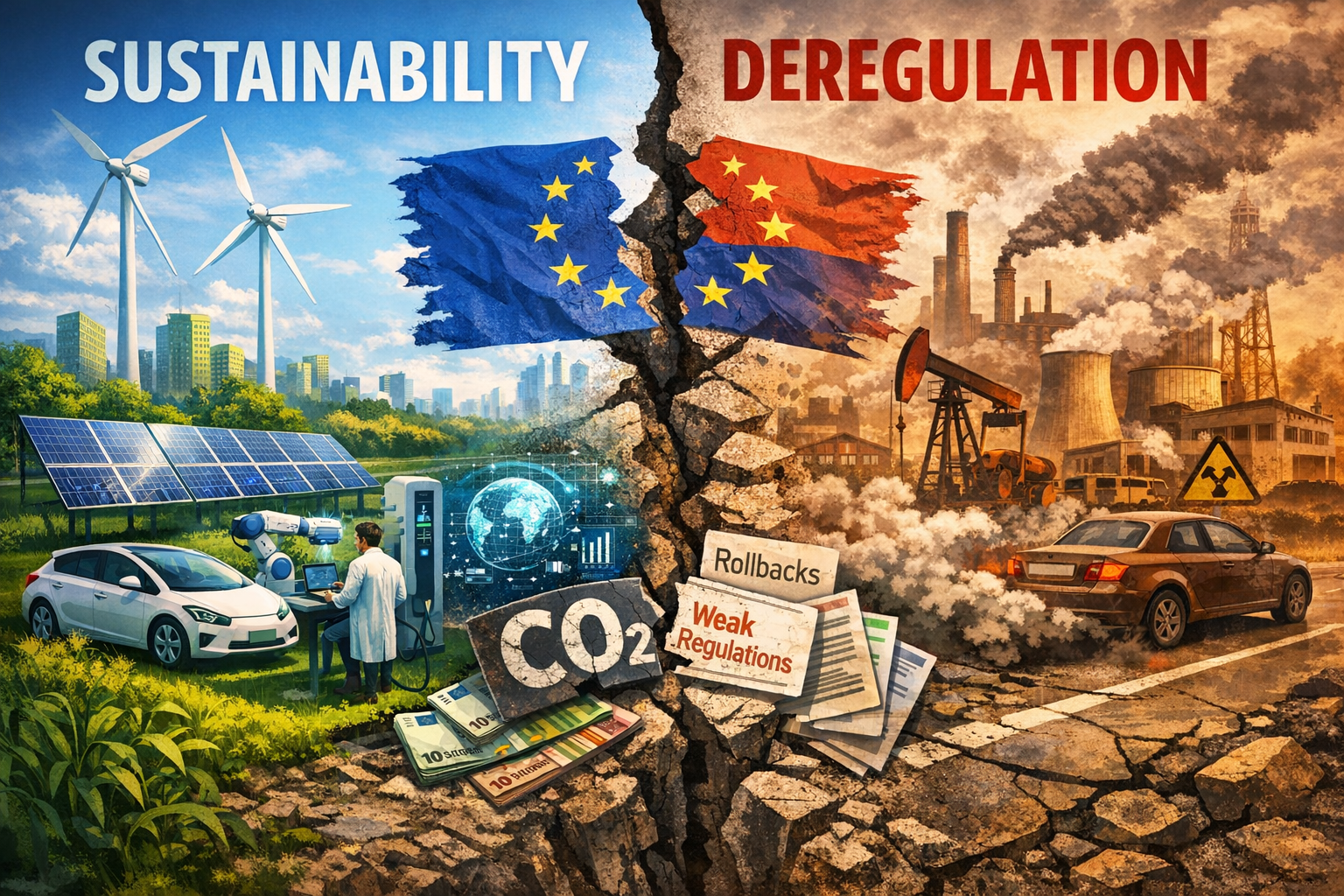 As Europe begins 2026, the continent finds itself at a crossroads in the governance of sustainability, technology and industry. Policymakers across the European Union and the United Kingdom are increasingly embracing deregulatory reforms, promoted as necessary to enhance competitiveness, stimulate investment and ease administrative burdens on business. Yet these reforms, when examined together, reveal a structural shift away from the sustainability frameworks that have shaped corporate accountability, environmental protection and long term innovation strategies over the past decade. This shift is more than a matter of regulatory calibration, reflecting a political economy in which deregulation is treated as an end rather than a means.
 ElectroMate