
Resilience, AI, and the sustainability rift revealed at Davos

When the World Economic Forum convenes each year in the Swiss Alps, it performs the paradox of a gathering of global elites claiming to represent the world even as they expose its fractures. In 2026, that paradox was laid bare by a tale of two speeches, one by Canadian Prime Minister Mark Carney that mourned the decline of a rules based global order and called for a cooperative response, and another by a U.S. president whose rhetoric reflected a very different, often unilateral, logic of power. The contrast between these visions mirrors the tensions now surfacing across the technological and environmental frontiers where AI and sustainability intersect.

Carney’s address was striking not simply for its sharp geopolitical diagnosis, that the orders of the past are fracturing under the strain of great power rivalry, but because it explicitly linked this rupture to the need for collective responses grounded in values, sovereignty, and sustainable development rather than coercion. He challenged the Davos audience to stop invoking an illusion of rules based stability and instead build alliances that reflect the realities of geopolitical competition and ecological crisis.

In contrast, and much commented upon in the global press, other speeches and reactions at Davos captured a very different mood, represented by competition over strategic assets like Greenland, tariff threats, and rhetorical appeals to national ascendancy rather than shared stewardship. This tension, between cooperation and competitive assertion, has direct implications for how humanity manages two of the defining challenges of our era: the governance of AI and the sustainability of our planetary systems.

AI, sustainability, and the fragility of resilience

In their idealised forms, AI and efforts to decarbonize our economies might seem complementary, where intelligent systems optimise energy use, accelerating climate modeling, and enhancing adaptive capacity across sectors. Yet at Davos, the debate revealed that the very governance structures which will shape AI deployment and climate action are also splitting along familiar economic and geopolitical lines.

On the AI front, discussions underscored a stark asymmetry: while leaders in the Global North emphasise competitiveness, AI sovereignty, and market advantage, much of the Global South worries about infrastructural dependency, digital extraction, and corporate control. From the vantage of emerging and middle powers, AI is less a tool of empowerment than a conduit through which external norms and economic leverage are exercised. This divergence mirrors long standing concerns that sustainability commitments are too often decoupled from the very power asymmetries that produce environmental harm in the first place.

The sustainability dimension was itself present in panels emphasising the environmental costs of AI, from energy intensive data centers to the material extraction required for high performance computing hardware. Leaders at Davos spoke of human centered AI and structural responses like AI taxation and safety nets for displaced labour, yet such frameworks remain aspirational and unevenly backed by policy. Where AI is subsidised without ecological accounting, efficiency gains risk becoming externalising mechanisms, one of improvements on paper that shift costs onto communities, ecosystems, and future generations.

A fractured global response to shared risk

The rift revealed in Davos reflects deeper structural tensions, in technological competition versus collective stewardship, national sovereignty versus transnational governance, and short term advantage versus long term ecological and economic viability. Carney’s call for middle powers to act together is, at its heart, a plea for a world that sees cooperation not as a luxury but as a survival strategy.

This is precisely where resilience must be rethought. Resilience cannot be merely adaptive; it must be transformative. It must take into account the uneven capacities of countries and communities to shape the trajectory of both AI and sustainability transitions. A Global South community that cannot contest algorithmic systems or influence data governance will find itself bearing not just technological dependencies but also environmental burdens and economic marginalization.

Carney’s framing, that the old order is gone and a new one must be built consciously, cooperatively, and sustainably, resonates with broader debates about the limits of adaptation. Resilience without justice is hollow, as adaptation that ignores structural inequities will reproduce vulnerability rather than dissipate it.

Toward a new architecture of governance

A truly sustainable and resilient future demands coherence between AI governance, climate policy, and global economic structures, and Europe has shown how can be done. This requires at least four shifts:

  • Distributed Agency: AI systems must be designed and governed as public infrastructures, not proprietary black boxes controlled by a handful of hyperscale firms and powerful states. This is essential for equitable resilience.
  • Ecological Accountability: AI’s environmental footprint, from hardware lifecycles to energy demand, must be integrated into governance frameworks, not treated as an afterthought in efficiency narratives.
  • Transnational Cooperation: The fractures evident at Davos remind us that unilateral power politics undermine collective action. Shared risks, climate tipping points, AI displacement, digital exclusion, cannot be managed by any one state acting alone.
  • Capacity Building in the Global South: Resilience will be meaningful only if countries with fewer resources can shape rules rather than have them imposed, whether in trade, technology, or climate finance.

Governance as the central frontier

The Davos narratives of 2026, from geopolitical tensions over Greenland to calls for new alliances, highlight the fundamental truth that we are living through a structural rupture, not a smooth transition. The futures of AI governance and sustainability are not separate questions; they are interlocked because both challenge the assumptions of unilateral power, short term gain, and technocratic neutrality.

To cultivate resilience in this era is not to adapt quietly to what is coming, but to forge systems of governance that reflect human values, ecological limits, and shared vulnerability. As global discussions fragment along lines of power and interest, the risks of fragmentation grow. But so does the possibility that communities, cities, nations, and coalitions, especially those historically marginalised, will insist on governance that is inclusive, sustainable, and just.

Our resilience, and that of the planet, depends on nothing less.
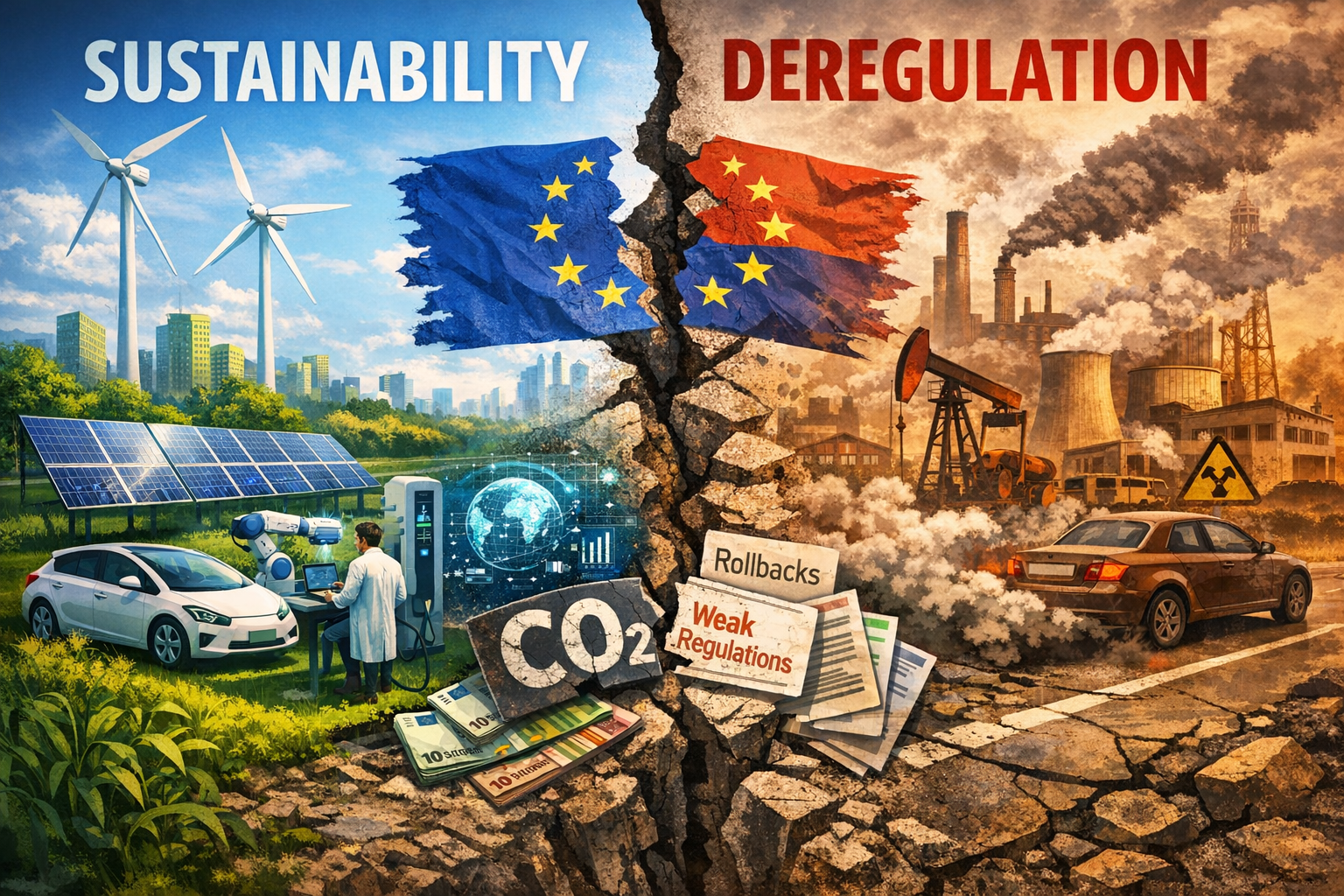
What Europe’s Policy Reversals Mean for Sustainability, Business and AI

As Europe begins 2026, the continent finds itself at a crossroads in the governance of sustainability, technology and industry. Policymakers across the European Union and the United Kingdom are increasingly embracing deregulatory reforms, promoted as necessary to enhance competitiveness, stimulate investment and ease administrative burdens on business. Yet these reforms, when examined together, reveal a structural shift away from the sustainability frameworks that have shaped corporate accountability, environmental protection and long term innovation strategies over the past decade. This shift is more than a matter of regulatory calibration, reflecting a political economy in which deregulation is treated as an end rather than a means.

Recent policy changes, from the weakening of the EU’s sustainability reporting regime and shifts in nuclear regulation, to the potential rollback of the 2035 internal combustion engine ban and pressure to relax AI governance frameworks, suggest a broader reorientation. The cumulative effect is to elevate short term economic calculations over long term resilience and systemic stewardship.

1. The Retreat from Sustainability Reporting

Just last week, the European Council and the European Parliament agreed to significantly simplify the Corporate Sustainability Reporting Directive (CSRD) and the Corporate Sustainability Due Diligence Directive (CSDDD). Under the revised framework, only companies with over 1,000 employees and €450m in annual turnover remain in scope for mandatory sustainability reporting, while due diligence obligations now apply only to firms with more than 5,000 employees and €1.5bn in turnover. Moreover, mandatory climate transition plans and certain reporting requirements were eliminated, and a large proportion of smaller businesses were exempted from the rules entirely. This retreat removes approximately 90 % of companies from CSRD’s scope and 70 % from CSDDD’s remit, dramatically shrinking the regulatory perimeter of corporate accountability.

What was initially designed to standardise environmental, social and governance (ESG) disclosures now risks becoming an optional add-on. The scaling back of reporting thresholds reduces transparency and weakens the incentives for firms to integrate sustainability into core business strategies. Rather than equipping investors and stakeholders with reliable data on climate risk, supply chain impacts and human rights performance, the revised regime favours voluntary approaches, an outcome that benefits larger firms with entrenched reporting capacities but leaves rising enterprises and mid sized suppliers in a regulatory limbo.

2. Deregulation in High-Risk Sectors

The United Kingdom’s efforts to streamline nuclear regulation similarly illustrate the risks of deregulation in domains where environmental and safety stakes are high. Recent proposals to simplify planning, environmental and safety oversight for nuclear projects have drawn criticism for sidelining ecological expertise and reducing the scope of environmental assessments. While proponents argue that regulatory fragmentation has contributed to high costs and delays, critics warn that diminishing safety and environmental safeguards could erode public trust and undermine long term energy sustainability.

Similar tensions are visible across energy policy more broadly. Though the EU has prioritised energy grid upgrades and infrastructure resilience in recent years, the broader deregulatory frame risks reducing environmental assessment to procedural formality rather than substantive governance, especially when energy transitions intersect with local ecological concerns.

3. The Combustion Engine Backtrack

Shortly before Christmas 2025, yesterday to be precise, the European Commission announced a major shift in its automotive climate policy, proposing the easing of the 2035 ban on new internal combustion engine (ICE) vehicles, following intense pressure from Germany, Italy and major automakers. Under the original rule, all new cars and light vans sold in the EU from 2035 were to emit zero tailpipe CO₂. The revised plan now targets a 90 % reduction in CO₂ emissions from 2021 levels by 2035, instead of a full zero emission mandate, and allows continued sales of plug-in hybrids and vehicles powered by synthetic fuels or non-food biofuels.

The retreat from a hard combustion engine ban comes amid headwinds for the European auto industry, slower than expected electric vehicle (EV) adoption, intense competition from Chinese EV manufacturers, and rising costs for infrastructure and battery supply. Automakers have lobbied vigorously for flexibility, arguing that plug-in hybrids, biofuels and alternative compliance schemes are necessary to preserve jobs and industrial capacity.

Environmental advocates and many EV-focused companies, including Volvo, have criticised the shift as a setback for Europe’s climate leadership, a potential drag on investment in electrification, and as a move to hide the sector’s inefficiencies and poor business choices. Critics argue that diluting the target undermines regulatory predictability and could leave Europe lagging in the rapidly growing global EV market, especially as China accelerates battery vehicle deployment and U.S. policy oscillates between incentives and rollbacks.

From a sustainability perspective, this reversal illustrates how deregulatory pressures can reshape climate policy itself, not merely loosen reporting obligations or reduce paperwork, but recalibrate the very targets that define long term decarbonisation pathways.

4. AI Governance in a Deregulatory Era

Artificial intelligence poses similar governance challenges. AI technologies increasingly permeate business operations, supply chain optimisation, resource allocation and sustainability analytics. Their environmental footprint, particularly through energy intensive model training and data centre operations , is substantial, and their social impact, from labour displacement to bias amplification, is profound. Effective governance is essential to ensure that AI contributes to sustainability rather than undermines it.

Yet political pressure, particularly emanating from competitors with more permissive regulatory regimes and large corporations’ lobbying, pushed Europe toward weaker AI oversight. The result is a tension between the original EU’s risk based AI governance framework and the deregulatory narrative that frames oversight as antithetical to innovation. In practice, well designed regulation can enable innovation by providing legal certainty and aligning technological development with societal values; absence of regulation often results in fragmented standards, ethical harms and competitive disadvantage.

5. Competitive Pressures and Policy Drift

Across sectors, the deregulatory narrative shares a common rationale, and regulation is portrayed as a barrier to competitiveness; those who seek licence to profit over anything else, and to externalise their costs, have succeeded in equating regulation to sovietisation, when the truth is far from it. Whether in sustainability reporting, automotive emissions targets, nuclear licensing or AI oversight, the same fallacious claim resurfaces, regulatory simplification will catalyse growth. But this logic is flawed when it conflates short term cost reduction with strategic competitiveness. True competitiveness for businesses, particularly in the 21st century, depends on resilience, innovation rooted in environmental and social performance, and the ability to operate within predictable, transparent policy frameworks.

European firms have historically outperformed competitors in regulated spaces precisely because regulation provided structure for investment in long-term capabilities, from vaccines to aerospace and advanced manufacturing. Regulatory retreat does not inherently create advantage; it creates uncertainty.

In recent years, Europe delivered two of the COVID-19 vaccines that enabled the global economy to restart (and those invented outside the Europe also had a substantial, if not complete, state support via a pro innovation regulated environment), created the World Wide Web, and fielded aerospace technologies that continue to outperform global competitors. Airbus’ consistent lead over Boeing in deliveries, bolstered by its sustained investment in sustainable aviation and hydrogen propulsion, illustrates how regulated environments can support innovation more effectively than more permissive systems dominated by short term financial priorities that end in inefficiencies created by continuous diversion of funds and energy for damage control.

In defence technology, European capabilities such as the Meteor missile demonstrate innovation at the technological frontier, which is being adopted by other countries. In quantum communications, Europe is building coordinated sovereign capabilities, exemplified by the Eagle-1 satellite, which aims to provide secure continental networks based on quantum key distribution. These advancements are neither accidental nor the product of deregulation. They arise from structured governance, sustained investment and regulatory clarity.

Reframing Regulation as Sustainability Infrastructure

Europe’s recent policy shifts reflect more than political compromise; they signal a broader philosophical shift that elevates short term competitive narratives over the systemic goals of sustainability, transparency and innovation governance. Deregulation is not inherently harmful, but when it diminishes accountability frameworks, erodes environmental targets and reduces regulatory certainty, it undermines well-being, investor confidence and climate action.

Sustainability is not an add-on to economic policy. It is economic policy, a structural condition for resilience, competitiveness and societal stability in a world defined by the climate crisis, technological disruption and demographic change. To preserve Europe’s sustainability leadership, policymakers must recognise regulation not as a burden but as essential infrastructure, a basis on which responsible business, robust markets and trustworthy technology can thrive in the decades ahead.