
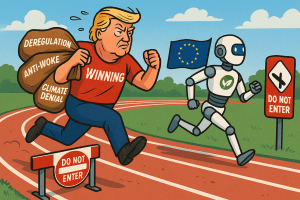
The Trump Administration just released America’s AI Action Plan, a bold, sweeping roadmap to secure what it defines as “unquestioned and unchallenged global technological dominance.” Framed as an existential race against geopolitical rivals like China, this plan sets out to transform every major sector of American life, industry, national security, infrastructure, education, through Artificial Intelligence. It is unapologetically ambitious, deregulatory, and ideologically driven, although these last factors with their clear anti science rhetoric may result in not achieving its stated aims.
The document is riddled with contradictions, selective interpretations of freedom, and a startling disregard for the pressing global challenge of sustainability. Yet, beneath the rhetoric and nationalist framing, there are pockets of pragmatic proposals, especially in sector-specific AI deployments, workforce development, and open source AI infrastructure, that deserve serious engagement.
At its core, the AI Action Plan reads like a manifesto for accelerationism without brakes. The opening pages reject previous efforts at cautious regulation, like Biden’s Executive Order 14110, and embrace full-speed deployment of AI, unburdened by red tape, environmental considerations, or ethical frameworks. The plan’s repeated insistence on removing regulatory barriers casts oversight itself as a threat, particularly oversight related to misinformation, diversity, climate change, and human rights. Paradoxically, based purely on ideology, the Office of Science and Technology Policy is tasked not with strengthening public interest safeguards but with rescinding rules deemed ideological or anti innovation.
This deregulatory zeal extends to infrastructure. Environmental protections under NEPA, the Clean Air Act, and the Clean Water Act are portrayed as inconvenient obstacles to building the data centres and energy systems AI needs. Climate considerations are not just omitted, they are actively scrubbed from public standards, with an explicit instruction to eliminate references to climate change from NIST frameworks. While this framing may excite Silicon Valley libertarians, and others poised to profit from unrestrained business activities, it raises the question of what kind of AI ecosystem will be the US building if the very values that ensure justice, accountability, and environmental sustainability are excised from its foundation.
One of the starkest contradictions in the plan is its call to defend freedom of speech in AI systems, followed immediately by a directive to suppress content or models that reflect so-called social engineering agendas or woke values. That is, according to the drafters of the policy, freedom of speech is guaranteed by prohibiting speech, which the equivalent of organising free orgies to promote virginity.
For instance, developers must ensure that their systems are “free from top-down ideological bias” a phrase used to justify banning government procurement of AI that acknowledges diversity, equity, climate change, or structural inequality . This narrow conception of objectivity suggests that any model reflecting progressive or globally accepted norms is inherently suspect. Accordingly, the Action Plan’s version of freedom seems to operate on a one-way street. It welcomes open dialogue, unless that dialogue challenges the current administration’s values. The implications for academic freedom, AI ethics research, and inclusive policymaking are profound, all of what are paramount for sustained innovation.
Perhaps the most glaring omission is the complete lack of any serious engagement with sustainability. Despite dedicating an entire pillar to AI infrastructure, including data centres, semiconductors, and the national grid, there is not a single reference to sustainable development goals, carbon emissions, or green AI. Instead, the plan explicitly promotes the expansion of energy intensive infrastructure while celebrating the abandonment of “radical climate dogma”. The phrase “Build, Baby, Build” is invoked as a national imperative, with energy consumption framed only as a barrier to be bulldozed through.
This omission is especially concerning given growing global awareness that AI, particularly large scale models, can have significant carbon footprints. The EU AI Act and many national strategies now link AI policy with broader climate objectives, not forgetting that the global investment in the low carbon energy transition reached $2.1 trillion in 2024. America’s plan, by contrast, treats environmental sustainability as a politically inconvenient distraction, and risks leaving the US out of the innovation fuelled by those funds. This leaves the U.S. not only misaligned with international efforts, but also vulnerable to long term economic and environmental risks.
However, amid the ideological rhetoric and the toddler-like phrases, there are components of the Action Plan that are thoughtfully constructed and potentially transformative, especially where the focus shifts from populism and geopolitics to sectoral applications and innovation ecosystems.
The plan calls for targeted AI adoption strategies in critical sectors such as healthcare, manufacturing, agriculture, national security, and scientific research. It supports regulatory sandboxes and domain specific AI Centres of Excellence, mechanisms that can help scale safe and effective innovation in complex environments.
Initiatives to modernise healthcare with AI tools, apply AI in advanced manufacturing, and support biosecurity research show a clearer understanding of AI’s potential for real world impact. If implemented with inclusive governance, these initiatives could significantly enhance productivity and resilience in key sectors, although as presented risk to leave outside of the funding pool those who focus on the environmental impact of their investments.
The Plan’s provisions to retrain and upskill American workers seem also well conceived, recognising the labour market disruption AI may cause and proposing concrete steps, from expanding apprenticeships and AI literacy in technical education, to tax incentives for employer-sponsored training. The establishment of an AI Workforce Research Hub could, if well supported, provide crucial data and forward looking analysis on job displacement, wage effects, and emerging skill demands. It has to be seen how the need for serious research is balanced with the constant attack to some of the world’s top research institutions.
The Plan’s strong endorsement of open weight and open source models may be one of its most forward looking elements. These models are essential for academic research, governmental transparency, and innovation outside the Big Tech ecosystem as, unlike closed source systems that concentrate power, open models allow more equitable access and experimentation.
Furthermore, the commitment to build a sustainable National AI Research Resource (NAIRR) infrastructure and improve financial mechanisms for compute access, especially for researchers and startups, is a rare bright spot. It signals an intention to diversify the AI innovation ecosystem but, again, it might collide with the constant defunding and battling of the White House with serious research institutions.
Finally, the Plan’s third pillar, international diplomacy and AI security, seeks to export “the full American AI stack” to likeminded nations while isolating rivals, particularly China. The aim is to create a global alliance built around U.S. developed hardware, standards, and systems. Here the plan may hit hard against reality, as the constant undermining of diplomatic principles and rules by the US government, and the growing lack of trust at global scale of American commitment to and international system based on rules, may result in countries looking for solutions elsewhere.
Without shared values of sustainability, fairness, and rights based governance, will the world want what America is selling? The EU, Canada, Brazil, and other global actors are increasingly anchoring AI governance in democratic accountability, inclusive participation, and climate conscious design. An American AI regime defined by deregulation and cultural exclusion may find limited traction outside its ideological bubble.
Ideology is the foundation of thinking, but when it replaces thinking, it may lead to a situation where the plans go against achieving the expected results, and some aspects of the America’s AI Action Plan might be a good example of that.
 ElectroMate